
The vital role of builders in West London renovations

TL;DR:
A skilled builder is essential for managing sequencing, quality, and costs in home renovations.
Proper coordination by builders prevents delays, rework, and budget overruns during each project stage.
Early builder involvement and clear planning contribute to more functional, efficient, and cost-effective renovations.
Many homeowners assume that planning a renovation is mostly about choosing finishes. Pick the tiles, select the paint colours, and the rest will follow. In reality, a home renovation is a complex, sequenced operation that requires expert co-ordination at every stage. The difference between a project that runs smoothly and one that spirals into delays and overspend often comes down to one thing: the quality of your builder. Whether you are planning a full refurbishment in Fulham or a kitchen overhaul in Kensington, understanding what a skilled builder actually does will help you make smarter decisions from day one.
Table of Contents
Key Takeaways
Point | Details |
Builders orchestrate complex renovations | Successful renovation projects require builders to plan, sequence, and manage every stage with precision. |
Proper sequencing avoids costly mistakes | Strict order of works ensures timelines stay intact and budget overruns are minimised. |
Professional builders save money in the long run | Expert oversight prevents pitfalls and manages local West London costs efficiently. |
Expert builders protect against common pitfalls | They spot and address issues like mission creep and trade clashes before they cause major problems. |
Why builders are essential to successful renovations
It is easy to think of a builder as someone who simply carries out instructions. But in a full-scale home renovation, your builder is far more than a pair of hands. They are the project steward, responsible for turning your vision into a functioning, finished home. From the moment work begins, a skilled builder is managing people, timelines, materials, and standards all at once.
One of the most underappreciated aspects of the builder’s role is sequencing. Every renovation follows a strict order of works, and getting that order wrong is expensive. Renovation follows strict sequencing: strip-out first, then plumbing and electrics first fix, followed by plastering, tiling, painting, flooring, and finally the second fix. Skipping steps or overlapping trades incorrectly causes rework, and rework costs both time and money.
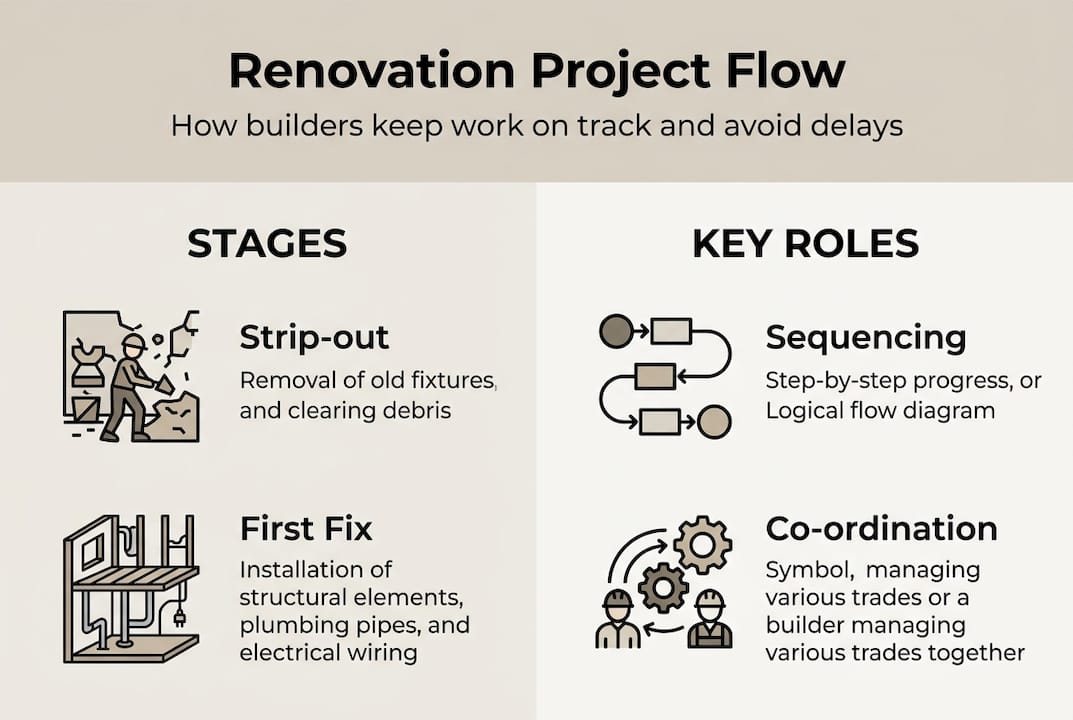
Beyond sequencing, your builder is the central point of communication between you and every trade on site. Plumbers, electricians, plasterers, tilers and decorators all need to know when to arrive, what to do, and how their work connects to the next stage. Without a builder co-ordinating this, trades clash, gaps appear, and your project stalls.
Here is what a professional builder manages on your behalf:
Project planning and scheduling across all trades and stages
Procurement of materials at the right time to avoid delays
Quality checks at each stage before the next begins
Compliance with building regulations and local authority requirements
Communication between you, the architect, and the trades
Problem-solving when unexpected issues arise on site
“A builder’s value is not just in what they build, but in what they prevent. Every problem caught early is a cost avoided later.”
If you are considering a major project, reading about how to transform your West London home will give you a clearer picture of what full-scale refurbishment involves. A thorough refurbishment checklist is also a practical starting point before any work begins.
Pro Tip: Before appointing a builder, ask them to walk you through their sequencing plan for your specific project. A builder who can explain the order of works clearly is one who genuinely understands what they are managing.
Sequencing and technical stages in a renovation project
With the rationale for engaging expert builders clear, let’s see exactly how they orchestrate the staged process of a renovation. A professionally managed renovation moves through defined phases, each one preparing the ground for the next. Rushing any stage creates problems that are costly and disruptive to fix later.
Here is how a typical West London renovation unfolds:
Strip-out — removal of existing fixtures, fittings, and any structural elements scheduled for change
First fix (structural and rough MEP) — structural framework, rough plumbing, and electrical cabling installed within walls and floors before they are closed up
Plastering and screeding — walls and floors prepared for finishes
Second fix (finishes and fittings) — 1st fix precedes 2nd fix; sockets, switches, sanitaryware, and kitchen units fitted after surfaces are complete
Tiling and flooring — applied once walls and floors are structurally sound and level
Painting and decorating — completed after tiling to avoid damage
Snagging and handover — final checks, touch-ups, and client walkthrough
Poor sequencing is one of the most common causes of renovation delays. When trades arrive out of order, work has to be undone and redone. A plasterer who finishes before the electrician has chased cables means opening walls again. A tiler who works before screeding is complete risks cracked tiles within months.
Stage | Key actions | Trades involved |
Strip-out | Demolition, removal, skip hire | Builder, labourer |
First fix | Cabling, pipework, structural timber | Electrician, plumber, carpenter |
Plastering | Skimming, screeding | Plasterer |
Second fix | Sockets, sanitaryware, joinery | Electrician, plumber, carpenter |
Tiling and flooring | Wall and floor finishes | Tiler, flooring specialist |
Decorating | Painting, wallpapering | Decorator |
Snagging | Final checks and corrections | Builder, all trades |
A well-managed project follows this refurbishment step-by-step guide to keep every stage on track. The builder’s role in aligning trades is what keeps the programme moving without costly gaps or overlaps.
Statistic: A full renovation that suffers from poor sequencing can add 20 to 30 per cent to the original budget through rework alone. Getting the order right from the start is not a luxury; it is essential.
Understanding costs: the builder’s influence on budgets
Having seen how builders structure the physical project, it is vital to consider their role in keeping your finances in check. West London renovations carry higher price tags than national averages, and for good reason. The market, the property sizes, the quality of finishes expected, and the complexity of working in period properties all contribute.
Full 100m² renovation costs typically range from £120,000 to £280,000 nationally (£1,200 to £2,800 per m²), with West London projects sitting firmly at the upper end of that range. Premium postcodes such as Chelsea, Notting Hill, and Kensington often exceed these figures for high-specification work.
A skilled builder’s influence on your budget goes well beyond their own labour costs. Here is where they add real financial value:
Accurate initial estimates that reflect the true scope of work, reducing the risk of nasty surprises
Transparent cost breakdowns so you know exactly where your money is going
Contingency planning — experienced builders build in a 10 to 15 per cent contingency for unforeseen issues, particularly in older West London properties
Trade relationships that bring competitive material and subcontractor pricing
Avoiding rework costs through correct sequencing and quality control
Cost area | Without professional builder | With professional builder |
Initial estimate accuracy | Often underestimated by 20%+ | Realistic from the outset |
Rework costs | High risk of significant rework | Minimised through sequencing |
Trade co-ordination | Gaps and delays likely | Smooth, scheduled handovers |
Regulatory compliance | Risk of failed inspections | Managed throughout |
Contingency planning | Often overlooked | Built into the budget |
For a detailed view of what to expect financially, our guide to West London refurbishment costs covers local market rates and what drives them. Understanding costs upfront is one of the most empowering things you can do before a project begins.
Common pitfalls and how skilled builders prevent them
Cost management is only part of the picture. Protecting your project from avoidable disasters is just as critical. Even well-intentioned homeowners fall into predictable traps, and the best builders know how to steer you clear of them.
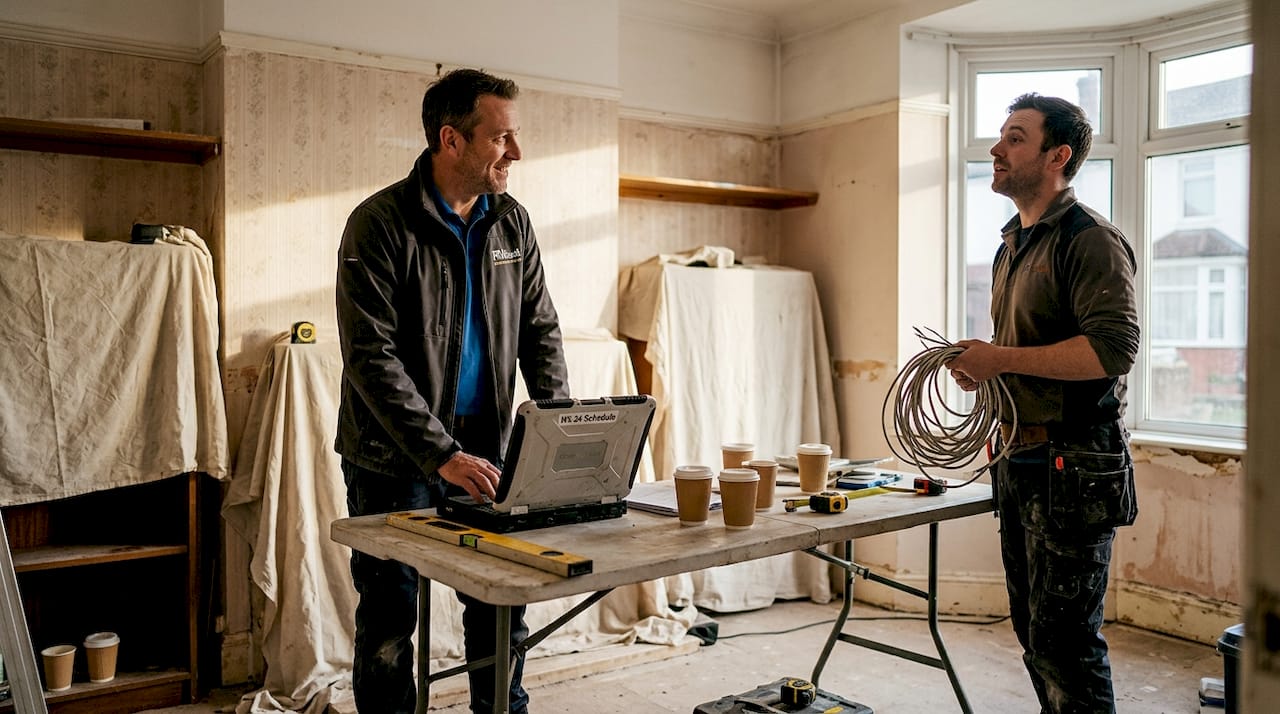
Common renovation pitfalls include mission creep, prioritising aesthetics over function, and poor trade sequencing. Mission creep is particularly common: the project starts as a kitchen renovation and gradually expands to include the utility room, the hallway, and then the downstairs toilet. Each addition seems small, but collectively they blow the budget and the timeline.
Here are the most frequent mistakes and how a skilled builder prevents them:
Mission creep — a good builder sets clear project boundaries at the outset and flags the cost implications of any changes before they are agreed
Style over function — beautiful kitchens that lack storage, or bathrooms with no ventilation, are common outcomes when aesthetics drive decisions without functional input
Poor sequencing — as covered earlier, this is the single biggest cause of delays and rework
Underestimating structural issues — period properties in West London frequently reveal hidden problems once strip-out begins; experienced builders anticipate and plan for these
Ignoring building regulations — non-compliant work can be costly to rectify and may affect your ability to sell the property later
“Before changing anything, observe how you actually use your home. The best renovations are shaped by real life, not just inspiration boards.”
Pro Tip: Spend at least two weeks noting how you move through your home before finalising any layout changes. Where do you naturally put your keys? Where does clutter gather? Your builder can use these insights to make genuinely functional improvements.
For specific projects, our guides on avoiding bathroom renovation mistakes and planning with our extension guide for West London homes offer practical, locally relevant advice.
Our take: what most renovation guides miss about builders
Most renovation guides treat builders as executors of a plan someone else has designed. In our experience, that framing misses the point entirely. The most successful projects we have been involved in are the ones where the builder was brought in before the design was finalised.
A skilled builder’s input at the pre-design stage can save months of hassle. They will flag structural constraints, highlight sequencing implications of certain layouts, and identify where specification choices will drive up costs unnecessarily. This is not about limiting your vision; it is about making your vision achievable.
The real differentiator between a good builder and a great one is not just workmanship. It is risk management, co-ordination, and the kind of value-added insight that only comes from years on site in West London properties. Builders who are perceived as mere tradespeople are often the ones who were never given the opportunity to contribute at the right stage. Browse our project portfolio to see what this approach looks like in practice.
Start your West London renovation with trusted professionals
Choosing the right builder is the single most important decision you will make for your renovation. Everything else, the finishes, the timeline, the budget, flows from that choice. A proven local builder brings not just skills but local knowledge, trusted trade networks, and a track record of delivering in West London’s unique property landscape.

At Tenen Ltd, we have been helping West London homeowners transform their properties since 2006. From full refurbishments to bathroom and kitchen renovations, we manage every stage with the care and precision your home deserves. Explore our property refurbishment services or discover our specialist bathroom and kitchen refurbishment offering. Get in touch today to discuss your project and take the first step towards a home you will love.
Frequently asked questions
What is the difference between a builder and other trades in renovations?
A builder manages renovation sequencing and co-ordinates the entire project, while trades such as plumbers and electricians focus on specific tasks within it.
How do builders help prevent renovation delays?
Poor sequencing causes delays and costly clashes between trades; builders enforce the correct order of works and address issues before they escalate.
Why are renovation costs higher in West London?
West London renovation costs are driven higher by premium property values, larger floor areas, high-specification finishes, and the complexity of working in period buildings.
Which renovation mistakes do builders commonly prevent?
Builders help avoid mission creep and poor sequencing, as well as layouts that prioritise appearance over practical, everyday function.
Recommended
Comments