
The role of interior designers in home renovations

TL;DR:
Interior designers combine creativity with technical expertise to manage entire renovation projects, from planning to final styling. They handle space planning, contractor coordination, compliance, and detailed documentation to ensure smooth, cost-effective results. Engaging a qualified interior designer early significantly improves decision-making, resale value, and project success while preventing costly mistakes.
Interior designers are defined as professionals who combine creative vision with technical expertise to plan, manage, and transform interior spaces into environments that are both beautiful and fully functional. Their work goes far beyond choosing paint colours or arranging furniture. A qualified interior designer, often holding credentials from bodies such as the British Institute of Interior Design (BIID) or the Chartered Society of Designers, manages everything from space planning and building regulation compliance to contractor coordination and final installation. For homeowners planning a renovation in London or anywhere in the UK, understanding what this role actually involves is the clearest way to judge whether hiring one is worth it. It almost always is.
What responsibilities do interior designers have throughout renovation projects?
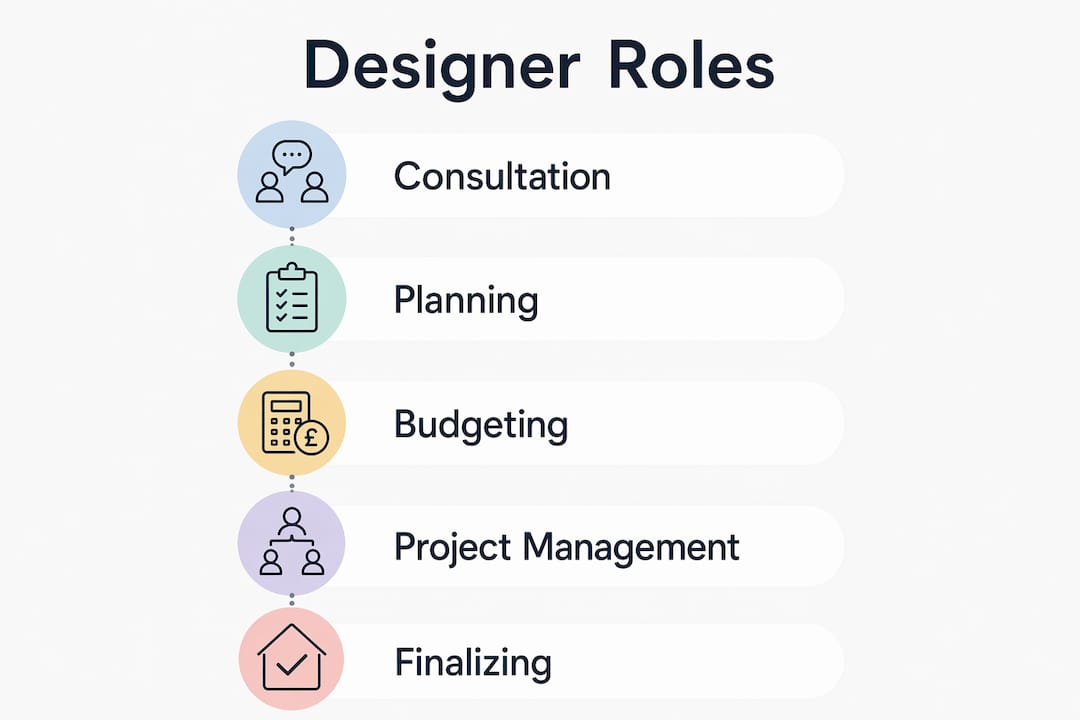
The role of interior designers spans the entire project lifecycle, from the first client conversation through to the final styling of a completed space. Professional interior designers oversee this full arc, collaborating closely with architects, contractors, and specialist trades at every stage. This is not a consultancy role that ends at the mood board.
The typical sequence of interior design responsibilities looks like this:
Initial consultation and programming. The designer meets with you to establish your goals, lifestyle requirements, and budget. This stage defines the brief and sets the parameters for every decision that follows.
Space planning and technical drawing. Using CAD software such as AutoCAD or SketchUp, the designer produces scaled floor plans, elevations, and technical drawings that guide structural and mechanical decisions.
Material and product specification. The designer selects finishes, fixtures, and furnishings, often sourcing from trade-only suppliers that are not available to the general public.
Contractor coordination. The designer acts as the central point of communication between builders, electricians, plumbers, carpenters, and other specialists, keeping everyone aligned with the design intent.
Construction oversight. Site visits allow the designer to check that work matches the approved drawings and resolve any on-site issues before they become expensive problems.
Final installation and styling. Once construction is complete, the designer oversees the placement of furniture, artwork, lighting, and accessories to deliver the finished result.
Financial management runs through every stage. Interior designers prepare detailed budgets, track expenditure, and apply value engineering when costs need to be adjusted without compromising quality. Interior design fees typically represent 10 to 20 per cent of total project costs, yet this investment consistently delivers a measurable return by preventing expensive errors and improving decision-making throughout the project.
Pro Tip: Bring your interior designer in before you finalise any structural decisions. Engaging designers early during the programming phase avoids costly changes to layouts, drainage routes, and mechanical systems that become far more expensive to alter once work has begun.

How do interior designers differ from interior decorators?
This distinction matters enormously when you are choosing who to hire. Interior designers manage both function and form, including structural considerations and regulatory compliance, while interior decorators focus primarily on aesthetic styling such as furniture selection, colour schemes, and accessories. Decorators generally do not produce technical documentation or hold formal design qualifications.
The table below sets out the key differences clearly.
Area | Interior designer | Interior decorator |
Scope of work | Space planning, technical drawings, building regulation compliance, full project management | Aesthetic styling, furniture, colour, accessories |
Technical documents | Produces CAD drawings, construction documents, and specifications | Does not typically produce technical documentation |
Qualifications | Degree-level education, professional membership (e.g. BIID, CSD) | No formal qualification required |
Regulatory knowledge | Understands building codes, planning rules, and safety standards | Limited or no regulatory involvement |
Project complexity | Suitable for structural alterations, extensions, and full refurbishments | Best suited to cosmetic updates and styling refreshes |
For a straightforward redecoration, a skilled decorator may be all you need. For a loft conversion, a kitchen extension, or a full property refurbishment, an interior designer’s technical and organisational capabilities are not optional. They are the difference between a project that runs smoothly and one that runs over budget and over time.
What technical and project management skills do interior designers bring?
Interior designers bring a level of technical rigour that most homeowners genuinely do not anticipate. Interior designers produce detailed construction documents that function as instruction manuals for every tradesperson on site, specifying dimensions, materials, finishes, and installation methods with precision. When these documents are absent or incomplete, tradespeople make assumptions, and assumptions cost money.
The project management dimension is equally significant. Consider what a designer actively manages on a typical London refurbishment:
Timeline management. The designer creates and monitors a procurement schedule, ensuring materials arrive on site when needed rather than weeks late.
Budget tracking. Costs are logged against the approved budget at every stage, with early warnings when expenditure is drifting.
Multi-trade coordination. Designers coordinate with architects, builders, and contractors to maintain continuity across all workstreams, preventing the classic scenario where one trade’s work blocks another’s.
Building code compliance. The designer checks that all work meets current UK building regulations, reducing the risk of failed inspections or costly remedial work.
On-site problem resolution. When unexpected issues arise, such as a hidden structural beam or a drainage conflict, the designer resolves them quickly within the design intent rather than leaving the decision to a builder who may not understand the wider scheme.
According to JL Coates project management experts, design is 80 per cent organisation and communication and only 20 per cent aesthetics. That ratio surprises most homeowners, but it explains why projects with a skilled designer in place consistently outperform those without one on both time and budget.
Pro Tip: When reviewing a designer’s portfolio, ask specifically about their project management approach and how they handle on-site conflicts. The answer will tell you more about their real value than any mood board.
What are the key benefits for homeowners of hiring an interior designer?
The benefits of hiring an interior designer extend well beyond a polished final result. For homeowners undertaking significant renovation work, the practical advantages are substantial and measurable.
Avoiding costly mistakes. Ignoring functional planning in favour of aesthetics is one of the most common homeowner errors, producing beautiful spaces that are genuinely uncomfortable or impractical to live in. A designer catches these problems at the drawing stage, where changes cost nothing.
Access to exclusive suppliers. Designers have access to trade-only vendors and artisans that are simply not available to the general public. This means your kitchen worktop, bathroom tiles, or bespoke joinery can come from suppliers whose quality and uniqueness you could not access independently.
Improved decision-making. Renovation projects involve hundreds of decisions, many of them interdependent. A designer structures this process, presents options with clear reasoning, and prevents the decision fatigue that leads homeowners to make expensive impulse choices.
Enhanced resale value. Strategic planning of flow, storage, and lighting improves both the functionality and the market appeal of a property. In competitive London postcodes such as Chelsea, Kensington, and Notting Hill, a well-designed interior is a genuine differentiator at the point of sale.
Peace of mind. Knowing that a qualified professional is monitoring every stage of your renovation, communicating with contractors, and checking compliance removes an enormous amount of stress from what is already a demanding process. You can also explore how 3D design tools are now used by designers to give homeowners a realistic preview of the finished space before a single wall is touched.
Key takeaways
Interior designers deliver the most value when engaged early, combining technical documentation, project coordination, and supplier access to protect your budget and transform your home.
Point | Details |
Early involvement saves money | Bringing a designer in before structural decisions prevents expensive changes to layouts and mechanical systems. |
Technical skills go beyond aesthetics | Designers produce CAD drawings and construction documents that guide tradespeople and reduce on-site errors. |
Designers differ from decorators | Interior designers manage compliance and project coordination; decorators focus on styling and do not produce technical documents. |
Exclusive supplier access | Trade-only vendors offer materials and finishes unavailable to the general public, raising the quality of your finish. |
Return on investment is measurable | Design fees of 10 to 20 per cent of project costs are offset by fewer errors, better decisions, and improved resale value. |
Why I believe homeowners consistently undervalue interior designers
Having worked alongside interior designers on refurbishment and extension projects across West London for many years, I can say with confidence that the most common misconception is this: homeowners think they are paying for taste. They are not. They are paying for organisation, technical knowledge, and the ability to hold a complex project together under pressure.
The clients who struggle most during renovations are those who attempt to coordinate trades themselves without a designer in place. They discover too late that a builder’s role and a designer’s role are genuinely complementary, not interchangeable. Builders execute; designers specify, coordinate, and resolve. When one is missing, the other is working without a complete set of tools.
The technical rigour involved in producing construction documents is something clients consistently underestimate. A good set of drawings prevents the kind of on-site ambiguity that leads to rework, delays, and budget overruns. I have seen projects saved at the eleventh hour because a designer’s documentation was precise enough to resolve a dispute between trades without any additional cost.
My honest view is that for any renovation involving structural work, a full refurbishment, or a significant room transformation, an interior designer is not a luxury. They are the professional who makes the difference between a project you are proud of and one you are still apologising for years later.
— Mateja
Transform your renovation with expert design and build support
At Tenenltd, we have been working with homeowners across Fulham, Chelsea, Kensington, Chiswick, and Hammersmith since 2006, delivering high-quality construction and refurbishment projects that benefit from coordinated design and build expertise. Whether you are planning a home extension, a full property refurbishment, or a kitchen and bathroom renovation, our team works alongside skilled designers to bring your vision to life with precision and care. Get in touch with Tenenltd to discuss your project and find out how we can support you from the first consultation through to the final finish.
FAQ
What does an interior designer actually do?
An interior designer plans and manages interior spaces from initial concept through to final installation, covering space planning, technical drawings, material selection, contractor coordination, and building regulation compliance. Their role combines creative and technical skills to deliver spaces that are both functional and visually cohesive.
How do I choose an interior designer for my renovation?
Look for a designer with formal qualifications from a recognised body such as the BIID or Chartered Society of Designers, a portfolio relevant to your project type, and a clear process for managing budgets and contractors. Ask how they handle on-site conflicts and what their construction documentation looks like before committing.
Is hiring an interior designer worth the cost?
Design fees typically represent 10 to 20 per cent of total project costs but consistently deliver a return by preventing costly errors, improving decision-making, and enhancing resale value. For any project involving structural changes or a full refurbishment, the investment is justified.
What is the difference between an interior designer and an interior decorator?
An interior designer manages both the functional and technical aspects of a space, including compliance with building regulations and the production of construction documents. An interior decorator focuses on aesthetic styling such as colour, furniture, and accessories, and does not typically produce technical documentation.
When should I bring an interior designer into my renovation project?
Bring a designer in before you finalise any structural or mechanical decisions. Early involvement during the programming phase allows the designer to optimise layouts and prevent expensive changes that become far more costly once construction has begun.
Recommended
Comments