
What is a build contract? A UK homeowner's guide

TL;DR:
A build contract is a legally binding agreement that defines scope, payment terms, responsibilities, and dispute procedures, with protections depending on its classification under the UK Construction Act. For homeowners, the residential occupier exclusion often limits statutory rights like adjudication and certain payment protections, making careful contract review essential. Choosing standard forms like JCT or NEC and documenting all project details significantly reduces risks and supports a successful construction project.
A build contract is a legally binding agreement between a homeowner or developer and a contractor, setting out the scope of work, payment terms, responsibilities, and what happens when things go wrong. In UK legal practice, this is more precisely called a construction contract, a term defined under the Housing Grants, Construction and Regeneration Act 1996 (commonly known as the Construction Act). Whether you are planning a rear extension in Fulham, a loft conversion in Chelsea, or a full refurbishment in Kensington, understanding your build contract agreement before you sign is one of the most valuable things you can do. Standard forms like JCT and NEC dominate UK construction, but bespoke agreements are equally common, and each carries different implications for your rights and risks.
What is a build contract under UK law?
A build contract, or construction contract, is defined broadly under the Construction Act 1996 to include building, demolition, repair, alteration, maintenance, and installation work on structures and land. This is wider than most homeowners expect. It covers not just the physical building work but also contracts with designers, consultants, and those who arrange or manage construction operations on your behalf.

The Act applies across England, Wales, and Scotland, giving it significant reach for any residential project. When a contract qualifies under the Act, it triggers specific legal protections around payment timing and dispute resolution, particularly adjudication. These protections exist because construction disputes are common and can be financially devastating without a clear legal framework to fall back on.
There are, however, notable exclusions. Contracts relating to oil and gas drilling, delivery-only agreements, and certain residential occupier contracts fall outside the Act’s scope. The residential occupier exclusion is particularly relevant to homeowners and is covered in detail later in this article.
Pro Tip: The ordinary meaning of “build contract” and the statutory definition of “construction contract” are not identical. Always verify whether your specific agreement qualifies under the Construction Act, as this determines which legal protections apply to you.
Key activities covered by the Construction Act include:
Building, alteration, repair, and maintenance of structures
Installation of mechanical, electrical, and plumbing systems
Demolition and preparation works
Design and consultancy agreements connected to construction operations
Contracts for arranging or managing construction work on behalf of another party
What types of build contracts do UK homeowners and developers use?
UK construction commonly uses standard form contracts such as JCT and NEC, alongside bespoke agreements tailored to specific projects. Each form allocates risk differently, and choosing the wrong one can leave you exposed to costs or disputes you did not anticipate.
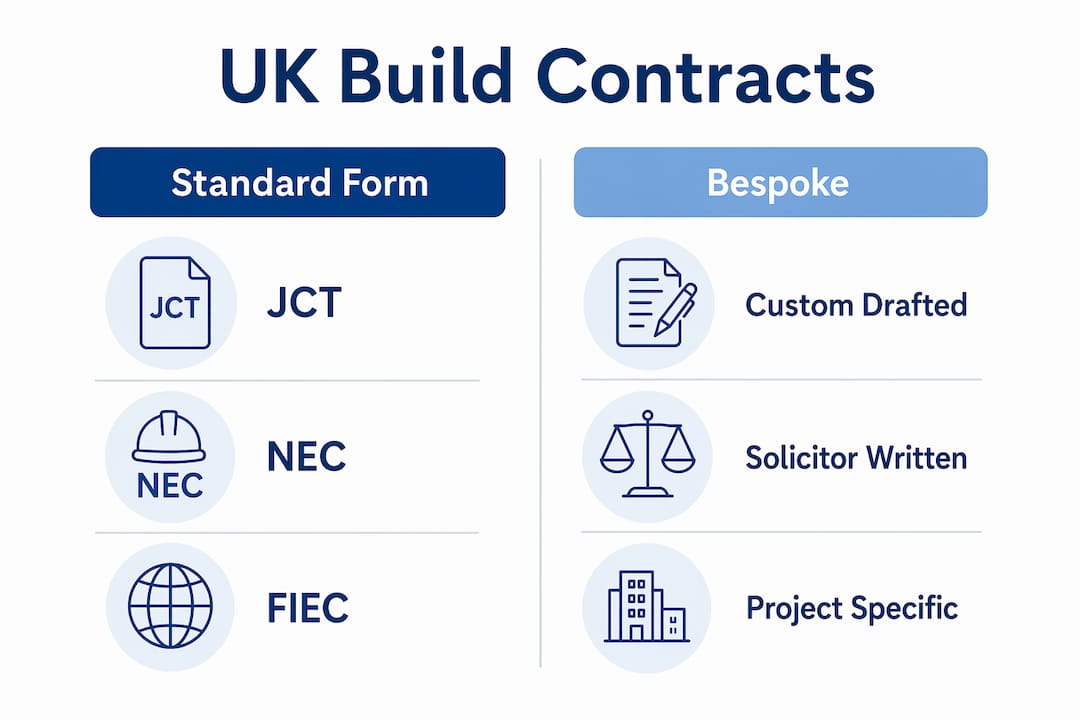
The Joint Contracts Tribunal (JCT) produces the most widely used suite of contracts in UK residential and commercial construction. The JCT Minor Works contract suits smaller, straightforward projects where the homeowner provides the design and the contractor simply builds. The JCT Standard Building Contract is more appropriate for larger projects with detailed specifications and a contract administrator overseeing progress. The JCT Design and Build contract shifts design responsibility to the contractor, which can simplify management but reduces your direct control over the outcome.
NEC contracts, published by the Institution of Civil Engineers, take a more collaborative and programme-focused approach. They are more common on larger infrastructure and commercial projects, but some developers use NEC for complex residential schemes. NEC contracts emphasise early warning systems and proactive management, which can reduce disputes but require more active administration from both parties.
Bespoke contracts are written specifically for a project, often by a solicitor or specialist construction lawyer. They offer flexibility but can inadvertently omit protections that standard forms include as a matter of course. The Construction Act applies to all qualifying agreements regardless of commercial title, whether standard form or bespoke.
Contract type | Typical use | Risk allocation |
JCT Minor Works | Small extensions, refurbishments | Contractor builds to homeowner’s design |
JCT Standard | Larger projects with contract administrator | Balanced between employer and contractor |
JCT Design and Build | Projects where contractor designs and builds | More risk transferred to contractor |
NEC | Complex or programme-heavy projects | Collaborative, shared risk approach |
Bespoke agreement | Unique or specialist projects | Varies entirely by drafting |
What key terms should you look for in a build contract?
A well-drafted construction contract sets out the work to be done, responsibilities, timing milestones, payment amounts and timing, and what happens if there are delays or variations. These core terms create legal certainty and reduce the risk of disputes by clearly defining expectations and remedies from the outset.
Here are the key elements to review carefully before signing:
Scope of work and specifications. The contract must describe precisely what the contractor will build, to what standard, and using which materials. Vague scope descriptions are the single most common source of disputes on residential projects.
Start date, milestones, and completion date. Clear dates protect you if the contractor falls behind. Without them, proving delay and claiming compensation becomes significantly harder.
Payment schedule and interim payments. Payment structures in build contracts are not mere preferences but legal requirements under the Construction Act when it applies. Interim payment provisions, payment notices, and pay less notices all carry strict timing rules.
Variations procedure. Any change to the agreed scope should be confirmed in writing before work begins. Without a formal variations clause, contractors can claim additional costs for work you assumed was included.
Role of the contract administrator or employer’s agent. On larger projects, a third party often certifies payments and manages the contract on your behalf. Knowing who holds this role and what authority they have is critical.
Delay and extension of time provisions. The contract should specify which events entitle the contractor to more time, and which entitle you to damages for late completion.
Dispute resolution. Adjudication is the statutory default for qualifying construction contracts. Arbitration and litigation are alternatives. Knowing your options before a dispute arises puts you in a far stronger position.
Pro Tip: Payment notice timing is one of the most technically demanding aspects of construction contracts. Practitioners focus as much on procedural compliance as on the payment amounts themselves, because missing a notice deadline can cost you significant rights.
What exceptions and nuances affect homeowners specifically?
Section 106 of the Construction Act excludes contracts with residential occupiers from the Act’s payment and adjudication regimes. This means that if you are contracting for works on your own home, the statutory protections you might expect, including the right to adjudication and mandatory interim payment provisions, may not apply to you.
This exclusion is more significant than most homeowners realise. It means your contractor could, in theory, include payment terms that would be unlawful in a commercial construction contract. It also means you cannot automatically trigger adjudication as a fast, low-cost dispute resolution route if things go wrong.
The exclusion is fact-sensitive, with Court of Appeal guidance focusing on genuine intention and realistic occupancy at the time the contract is formed. Documenting your intention to occupy the property at contract formation reduces the risk of disputes about whether the exclusion applies.
The residential occupier exclusion under section 106 is especially important for homeowners, often removing statutory protections they may expect to have automatically. Never assume the Construction Act’s payment and adjudication rights apply to your home project without checking.
Further nuances to be aware of include:
Hybrid contracts. If your agreement covers both construction operations and non-construction services, only the construction parts may be governed by the Construction Act, and only if they are clearly distinguished within the contract.
Scope definition. How the contract defines the scope of work directly affects whether Construction Act protections apply, influencing your payment and dispute resolution rights.
Intention to occupy. Court rulings confirm that actual intention and realistic possibility of occupying the dwelling are key to applying the residential occupier exclusion. Keep written records of your intentions at the time you sign.
How should you approach a build contract to protect your interests?
Protecting your interests in a construction contract starts before you sign, not after a problem arises. The following steps give you a practical framework for engaging with any build contract agreement on your property.
Read the scope of work carefully. Do not assume anything is included. If a specific finish, material, or detail matters to you, it must appear in writing within the contract documents.
Seek professional advice before signing. A solicitor with construction experience or a qualified contract administrator can identify problematic clauses that are easy to miss if you are not familiar with construction contract basics.
Document your intentions clearly. If you intend to occupy the property, state this in writing at the time of contract formation. This is particularly relevant given the residential occupier exclusion discussed above.
Understand the payment mechanism. Know when payments are due, what triggers them, and what notice periods apply. Missing a payment notice deadline can forfeit your right to withhold payment even if the work is defective.
Manage variations in writing. Agree every change to the scope in writing before work proceeds. Verbal agreements about variations are a frequent source of costly disputes.
Maintain a project diary. Record site visits, conversations, and decisions throughout the project. This documentation is invaluable if a dispute arises months later.
Use a reputable local contractor. Working with an established builder in West London who understands both the practical and contractual aspects of residential construction reduces your exposure significantly.
For homeowners in areas like Fulham, Chelsea, or Kensington, engaging a trusted builder in Fulham who is experienced in residential contracts means you are working with someone who already understands the local planning context and typical project structures.
Key takeaways
A build contract is a legally binding construction agreement that defines scope, payment, responsibilities, and dispute rights, and its legal status under the Construction Act 1996 determines which protections apply to you.
Point | Details |
Build contract definition | A legally binding agreement covering scope, payment, responsibilities, and dispute resolution for construction work. |
Construction Act 1996 | Defines qualifying contracts and triggers statutory payment and adjudication protections when applicable. |
Residential occupier exclusion | Section 106 may remove key statutory protections for homeowners contracting on their own home. |
Contract type matters | JCT, NEC, and bespoke agreements allocate risk differently; choose based on project size and complexity. |
Document everything | Written records of intentions, variations, and communications are your strongest protection in any dispute. |
Why the paperwork matters more than most homeowners think
When I look at the projects that run into serious trouble, the contract is almost never the problem people thought it was. The real issue is usually that nobody read it properly before signing. Homeowners often treat the contract as a formality, something to get through before the exciting part begins. That mindset is expensive.
The residential occupier exclusion is the detail that surprises people most. Many homeowners assume they have full statutory protection simply because they are having work done on their home. The reality is more nuanced. If section 106 applies to your contract, you lose the right to adjudication and the mandatory payment provisions that protect commercial clients. That is a significant gap in your safety net.
I have also seen disputes that turned entirely on payment notice timing rather than the quality of the work itself. A contractor who follows the correct notice procedure can, in some circumstances, enforce payment even where defects exist, because the homeowner missed the window to issue a pay less notice. Understanding this before you sign changes how carefully you read the payment clauses.
My honest advice is to treat the contract as the project itself. A well-drafted agreement with a reputable contractor is not just paperwork. It is the foundation on which a successful renovation or extension is built.
— Mateja
How Tenenltd can help with your next project
If you are planning a home extension, loft conversion, or full refurbishment in London, Tenenltd brings nearly two decades of residential construction experience to every project. Founded in 2006, Tenenltd works with homeowners across Fulham, Chelsea, Kensington, Chiswick, Hammersmith, and Notting Hill, delivering high-quality workmanship with a professional approach to project management and contracting.

Understanding your build contract is the first step. Having the right team behind you is the second. Whether you are exploring a rear or side extension or considering a loft conversion to add space and value, Tenenltd guides you through the contractual and construction process from consultation to completion. Get in touch to discuss your project and find out how we can make your vision a reality.
FAQ
What is a build contract in simple terms?
A build contract is a legally binding agreement between you and a contractor that sets out what work will be done, when, how much it will cost, and what happens if problems arise. In UK law, it is formally called a construction contract and is governed by the Housing Grants, Construction and Regeneration Act 1996.
Does the Construction Act 1996 apply to my home renovation?
Not always. Section 106 of the Construction Act excludes contracts with residential occupiers, which means homeowners contracting for works on their own home may not benefit from the Act’s statutory payment and adjudication protections.
What is the difference between a JCT and a bespoke build contract?
JCT contracts are standard forms developed by the Joint Contracts Tribunal, widely used across UK construction and covering most residential scenarios. Bespoke contracts are written specifically for a project and offer flexibility, but the Construction Act applies to both types equally if the contract qualifies under its definition.
What should I always include in a build contract?
Every build contract should clearly state the scope of work, start and completion dates, payment schedule, variations procedure, and dispute resolution method. Without these elements, you have limited legal recourse if the project goes over budget, runs late, or produces defective work.
Can a verbal agreement count as a build contract?
A verbal agreement can technically constitute a contract under English law, but proving its terms in a dispute is extremely difficult. Always insist on a written build contract agreement before any work begins, regardless of how well you know the contractor.
Recommended
Comments