
How to choose a builder: a step-by-step UK guide

TL;DR:
Choosing a qualified builder requires verifying credentials, reviewing detailed, itemized quotes, and ensuring a clear management structure. Starting early and selecting from vetted schemes like the Federation of Master Builders or TrustMark helps identify reliable contractors with local reputations and proven quality. A professional contract with staged payments and documented proof of insurance safeguards your project from common risks and delays.
The right builder combines verified credentials, in-house project management, and a written, itemised quote tied to a Bill of Quantities. Start by booking site visits with three vetted candidates, each registered with the Federation of Master Builders or TrustMark, carrying public liability insurance with sufficient coverage, and willing to provide a named site manager. Tenenltd is one example of a London contractor that operates with director-level oversight and in-house trades, which is precisely the model experts recommend for reducing delays and cost overruns on residential projects.
Table of Contents
Where do you find vetted, reliable builders in the UK?
The most productive starting point is a vetted trade scheme rather than a general internet search. The Federation of Master Builders and TrustMark both require members to pass independent inspections before listing them, so a builder appearing on either register has already cleared a baseline quality check. Your local building control team or an approved inspector can also point you towards contractors they have seen perform well on similar projects in your area.
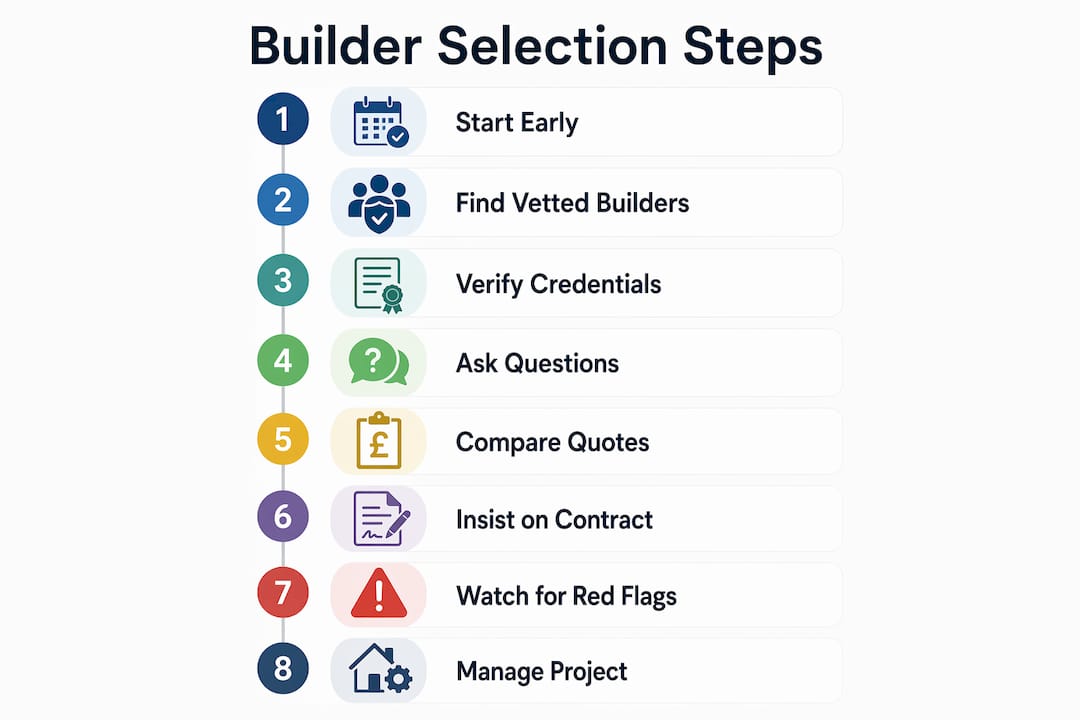
Beyond the registers, local contractors who are visibly active in your neighbourhood are worth approaching. A builder working two streets away has a reputational stake in doing good work nearby. Merchant recommendations are particularly underrated: ask local tradespeople such as plumbers and carpenters who they would trust, because merchants know which builders pay their accounts on time and run organised sites.
Review platforms such as Checkatrade and MyBuilder are useful for a first pass, but treat them as a starting point rather than a final verdict. Check that reviews are recent, that the builder has responded to any negative feedback, and that the profile shows a consistent track record rather than a cluster of reviews from a single period. Always verify any membership logo you see on a builder’s website directly on the issuing organisation’s site.
Pro Tip: Aim for a shortlist of 3–5 candidates. Quality builders are often booked months in advance, so start your search well in advance of needing work to begin.
How to verify a builder’s credentials and reliability
Checking a builder’s documents takes less than an hour and can save you thousands. Request the following before any site visit, and verify each item independently.

Document | What to check | Where to verify |
Public liability insurance | Minimum £2 million cover; £5 million for larger projects | Ask for the certificate; call the insurer to confirm it is live |
Employers’ liability insurance | Required by law if the builder employs staff | Certificate must show current dates and the employer’s name |
FMB or TrustMark membership | Active membership, not an expired logo | Check directly on fmb.org.uk or trustmark.org.uk |
Gas Safe / NICEIC / NAPIT | Required for gas and electrical work respectively | Search the register on the issuing body’s website |
Companies House filing | Confirms the company exists and is active | Free search at companieshouse.gov.uk |
VAT registration | Confirms legitimate trading status | HMRC’s online VAT checker |
Trade body membership is not compulsory in the UK, but it is a strong signal of quality. The FMB, TrustMark, NHBC, Gas Safe Register, and NICEIC each vet members independently, so verifying membership on the issuing site rather than trusting a logo on a builder’s brochure is the only reliable approach.
References matter as much as certificates. Ask for contact details for two or three recent clients on comparable projects, then actually call them. Ask whether the builder finished on time, whether the final cost matched the quote, and whether they would hire the same team again. If possible, arrange to visit a completed job and inspect the quality of finishes, junctions, and any structural work yourself.
Pro Tip: When you visit a completed project, look at the details a builder cannot easily hide: the straightness of tiling grout lines, the fit of skirting board joints, and the neatness of cable or pipework runs. These small details reveal workmanship standards far more honestly than a showroom.
What questions should you ask a builder at the first meeting?
Structured questions reveal far more about a builder’s competence than focusing on price alone. The following numbered list covers the core areas to probe at a site visit or first meeting.
Experience with this project type. Ask how many similar jobs they have completed in the past two years and request photos or site visits for at least one. A builder who has done multiple loft conversions will anticipate structural and planning issues that a generalist may not.
Team structure. Find out whether the trades are in-house employees or subcontractors. In-house teams tend to be more coordinated and accountable; if subcontractors are used, ask how they are selected and managed.
Named site manager. Who will be on site every day? A clear answer with a name and a brief background is a positive sign. An evasive response (“we’ll sort that nearer the time”) is not.
Programme and supervision. Ask for a draft programme showing key milestones and how many days per week the site manager will be present. A builder who cannot sketch a rough timeline at the first meeting has not thought the project through.
Pricing assumptions. What does the estimate include, and what is explicitly excluded? Ask about waste removal, scaffolding, building control fees, and VAT. Surprises in these areas are where budgets unravel.
Variations and cost control. How are changes priced during the project? A professional builder will describe a written variation order process; a vague answer suggests disputes ahead.
Warranties and snagging. What defects period do they offer, and how is snagging handled at the end of the job? Who signs off the work as complete?
Post-completion support. Will they return to address minor issues that emerge in the weeks after handover?
The difference between a clear and an evasive answer is usually obvious. A confident builder says: “Our site manager, James, will be on site Monday to Friday. We use a written variation order for any changes over £200.” An evasive builder says: “We’ll keep you posted as we go.” Trust the pattern, not the charm.
Pro Tip: Bring a written list of questions to every site visit and take notes. Comparing answers across three builders side by side is the best way to choose a contractor who is genuinely organised rather than merely personable.
How to get and compare quotes properly
Sending the same detailed brief to every builder is the only way to get quotes that are genuinely comparable. Without a Bill of Quantities or a detailed schedule of works, each builder will make different assumptions about materials, waste disposal, and site access, and price variance can be very wide even for identical projects.
A proper itemised quote should include:
Labour costs broken down by trade
Materials with brand or specification stated (not just “tiles” but “300×600mm porcelain, mid-range”)
Waste removal and skip hire
Scaffolding, if required
Building control fees
VAT, clearly stated as included or excluded
A defined variation order process for changes
The table below shows how the same extension project can look very different across three quotes when scope is not standardised.
Line item | Quote A | Quote B | Quote C |
Scaffolding | Included | Not mentioned | Included |
Building control fees | Included | Excluded | Included |
Waste removal | Included | Included | Excluded |
VAT | Included | Excluded | Included |
Stated materials spec | Yes | No | Partial |

Quote B may look cheaper at first glance. Add back the excluded building control fees and VAT, and it is likely the most expensive of the three. A transparent builder explains pricing assumptions rather than simply supplying the lowest figure, and that transparency is a reliable signal of professional procurement.
Common cost drivers that create variation between quotes:
Site access difficulties (narrow streets, no parking, restricted hours)
Structural surprises uncovered during strip-out
Materials specification upgrades requested mid-project
Specialist trades such as underpinning or heritage masonry
What contracts and payment terms should you insist on?
A written contract is essential for jobs above a modest threshold. The JCT Homeowner Contract and JCT Minor Works form are the industry-standard options for residential projects and are widely available. Both set out the scope, programme, payment terms, and dispute resolution process in plain language.
Contract element | What to require |
Written, itemised contract | JCT Homeowner or Minor Works for jobs over £5,000 |
Deposit | 10–15% maximum to secure the start date |
Stage payments | Tied to defined milestones, not calendar dates |
Retention | 5–10% held for 3–6 months to cover snagging |
Public liability insurance | Minimum £2 million cover; £5 million for larger projects |
Employers’ liability insurance | Required where the builder employs staff |
Structural warranty | NHBC or equivalent for new-build or major structural works |
A sensible payment schedule protects both parties. Pay a moderate deposit to secure your start date, then release further payments tied to agreed milestones. Hold back a retention amount until the snagging list is signed off after completion.
Key points to keep in mind:
Never pay more than 15% upfront, regardless of what a builder requests.
Always get a VAT invoice for every payment; cash payments with no paperwork are a serious warning sign.
Confirm that insurance certificates are current before work begins, not just at the quote stage.
If a builder proposes cash payments to avoid VAT, walk away. It exposes you to legal liability and leaves you with no paper trail if something goes wrong.
What are the red flags that a builder is unreliable?
Some warning signs are obvious only in hindsight. Knowing them in advance puts you in a much stronger position.
Large upfront payment demand. Any request for a large upfront payment before work starts is a red flag. Legitimate builders do not need you to fund their materials in advance.
Cash-only requests. No legitimate contractor should ask you to pay in cash to “keep costs down.” This removes your legal protections entirely.
No written quote or contract. A builder who resists putting things in writing is telling you something important about how disputes will be handled.
No fixed address or landline. A mobile number and a Gmail address are not sufficient. Verify a physical business address through Companies House.
Evasive answers on references. If a builder cannot provide two recent client contacts within 24 hours, treat that as a refusal.
No insurance proof. Asking for a certificate is standard. Reluctance to provide one is not.
Significantly lower price than all other bids. A quote that is 30–40% below the others usually means something is excluded, the materials are inferior, or the builder plans to request extras once work has started.
If you identify a red flag before signing anything, simply decline and move to the next candidate on your shortlist. If problems emerge during the project, stop payments for non-compliant work immediately, document every defect with dated photographs, and refer to the dispute resolution clause in your contract. The Building Control Partnership and Trading Standards are both useful escalation routes when a builder is unresponsive.
Pro Tip: Keep a project folder with copies of your contract, every invoice, every variation order, and all correspondence. If a dispute arises, this paper trail is your strongest asset.
Why does in-house project management produce better results?
Selection should begin long before the first quote arrives, with early focus on team structure and management style rather than price. Experts consistently find that a builder’s project-management model predicts outcomes more reliably than their initial estimate, because coordination failures between trades are the most common cause of delays and cost overruns on residential projects.
A builder with a named site manager, a written programme, and in-house trades removes the single biggest source of residential renovation delays: the gap between one trade finishing and the next arriving. When the same firm manages brickwork, carpentry, and first-fix electrics, scheduling conflicts are resolved internally rather than becoming your problem to chase.
The management signals worth requesting at tender stage are:
Named site manager with a brief CV or project history
A draft programme showing milestones and trade sequencing
A subcontractor roster with confirmation of how each is vetted
A reporting cadence (weekly site diary, photo updates, or progress meetings)
Director-level oversight for larger projects
Tenenltd’s model, with director oversight and a named site manager on every project, reflects exactly this approach. On a recent West London rear extension, in-house coordination between the structural, carpentry, and first-fix electrical teams meant the programme ran to schedule despite a late change to the structural beam specification. A fragmented subcontractor model would likely have added weeks to the programme in that scenario.
Key takeaways
Choosing the right builder comes down to verified credentials, a written contract with staged payments, and a project-management model that keeps trades coordinated from start to finish.
Point | Details |
Start early and shortlist carefully | Quality builders are often booked months ahead; compile 3–5 vetted candidates before requesting quotes. |
Verify documents independently | Check insurance, FMB or TrustMark membership, and Companies House directly, not from a builder’s brochure. |
Use a Bill of Quantities | A BoQ forces every builder to price the same scope, making comparisons genuinely like-for-like. |
Insist on a written contract and staged payments | Use a JCT Homeowner or Minor Works contract; cap the deposit at 10–15% and hold 5–10% retention for snagging. Minimum public liability insurance of £2 million; for larger projects, £5 million is recommended. |
Tenenltd for London projects | Tenenltd offers in-house project management, director oversight, and itemised quotes for extensions, loft conversions, and full refurbishments across West and Central London. |
The thing most homeowners get wrong when hiring a builder
Most people spend the most time comparing prices and the least time comparing how a builder actually manages a project. That imbalance is where renovation nightmares begin.
Price is easy to compare. Management quality is harder to assess, which is precisely why so many homeowners skip it. But a builder who charges 10% more and delivers a named site manager, a written programme, and weekly photo updates will almost always cost you less in total than a cheaper builder who leaves you chasing progress and resolving trade conflicts yourself.
The other thing that catches homeowners out is timing. People often start looking for a builder once planning permission is granted, which is already too late. By that point, the best contractors in your area are committed elsewhere for months. The design consultation stage is the right moment to begin shortlisting, so that when drawings are ready, you can move straight to tender with candidates who are already familiar with your project.
One more thing: do not mistake a polished website for a well-run business. The builders who invest most in their marketing are not always the ones who invest most in their sites. Ask for a site visit to a live project. Watch how the site is kept, how the team communicates, and whether the site manager can answer your questions without calling the office. That half-hour visit tells you more than any brochure.
How Tenenltd can help with your project
If you are planning a home extension, loft conversion, or full refurbishment in West or Central London, Tenenltd brings everything the guidance above recommends under one roof: in-house trades, a named project manager, director-level oversight, and a detailed itemised quote following a site survey.

Established in 2006, Tenenltd has worked with homeowners across Fulham, Chelsea, Kensington, Chiswick, Hammersmith, and Notting Hill on projects ranging from home extensions and loft conversions to full property refurbishments and kitchen and bathroom renovations. Every project begins with a thorough site survey, after which you receive a written, itemised quote with clear payment milestones and a named point of contact throughout. Get in touch with Tenenltd today to book your site survey and take the first step towards a well-managed, professionally delivered project.
Useful sources for verifying builder credentials
When you are ready to check a builder’s credentials, these are the authoritative UK sources to consult.
Federation of Master Builders — Search by postcode to confirm active membership. The FMB also operates a dispute resolution service for members’ clients.
TrustMark (trustmark.org.uk) — Government-endorsed quality scheme. Verify the builder’s registration number and check for any complaints on record.
Companies House (companieshouse.gov.uk) — Confirm the company is active, check filing history, and verify the registered address. Free to use.
Gas Safe Register (gassaferegister.co.uk) — Mandatory for any gas work. Search by engineer licence number to confirm current registration and the work categories they are licensed for.
NHBC (nhbc.co.uk) — Relevant for new-build or major structural works. Check whether the builder is registered and whether a Buildmark warranty applies to your project.
NICEIC / NAPIT — Verify electrical contractors’ registration for Part P compliance on domestic electrical work.
Trading Standards — Contact via the Citizens Advice consumer helpline if you have concerns about a builder’s conduct before or during a project.
Local building control — Your local authority’s building control team can confirm whether a builder has a history of compliant work on inspected projects in your area.
Keep dated screenshots or printed copies of every insurance certificate and membership confirmation you receive. If a dispute arises months into a project, having proof that cover was in place at the start of works is far more useful than a builder’s verbal assurance.
Recommended
Comments